

Back to Page
Amazon Australia
Amazon listing localisation: How to adapt listings for Australian buyers
Amazon listing localisation: How to adapt listings for Australian buyers
Amazon listing localisation: How to adapt listings for Australian buyers
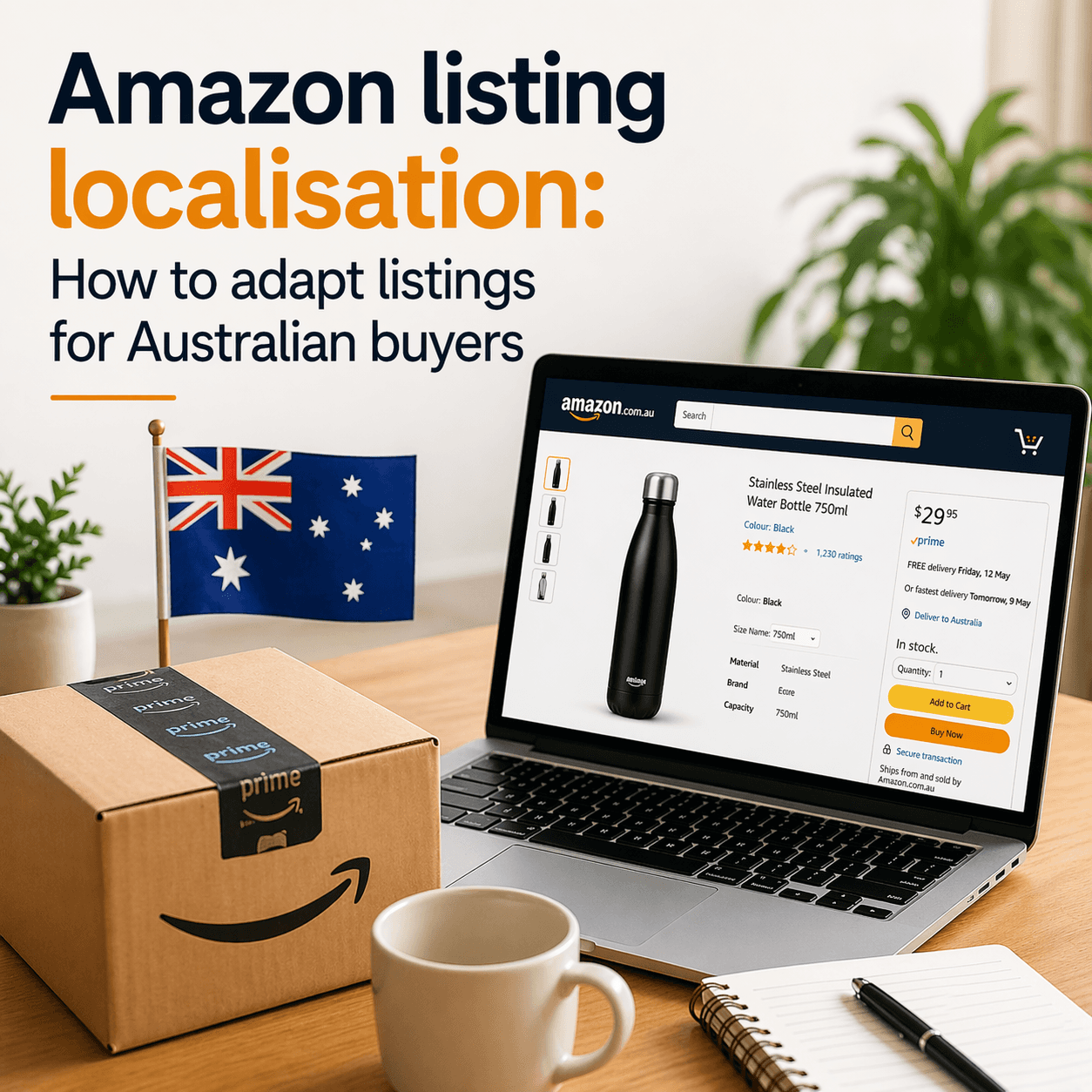
TL;DR
Amazon Australia requires true localisation, not just copying US or UK listings.
Australian English, metric units, and local search terms directly impact visibility and rankings.
Effective localisation includes keyword research, content adaptation, and alignment with AU buying behaviour.
Australian buyers prefer clear, honest, trust-focused content over aggressive selling.
Cultural factors like sustainability, trust signals, and local lifestyle imagery improve conversions.
Sellers who invest in proper localisation gain an early advantage in a fast-growing, less competitive marketplace.
Most sellers who expand to Amazon Australia make the same mistake on day one. They take their best-performing US or UK listing, hit duplicate, change the currency, and call it localised. Then they wonder why conversion rates are flat, rankings are disappointing, and their "proven" listing isn't performing the way it did at home.
Amazon Australia is not a smaller version of Amazon US. It's a distinct marketplace with its own search behaviour, its own cultural expectations, and its own vocabulary.
This blog discusses exactly what Amazon listing localisation Australia actually means in practice, covering language, buyer psychology, keyword strategy, content tone, and the specific elements of a listing that need to change before you go live.
Why do Australian spelling vs. US Amazon listings actually matter for rankings?
This is the question most sellers dismiss, until they realise Amazon's search index treats "organise" and "organize" as different strings.
Australian shoppers type in Australian English. They search for "colour," not "color." They type "aluminium cookware," not "aluminum cookware." They look for "nappy bags," not "diaper bags." They search for "capsicum" where an American would type "bell pepper." They want "beetroot," not "beet."
These are not stylistic preferences; they are search terms. If your title, bullet points, and backend keywords are written in American English, you are structurally invisible to a portion of the Australian search traffic that would otherwise find you.
The same logic applies to measurements. Australian buyers expect metric. A product listed as "fits mattresses up to 10 inches thick" creates immediate friction for someone thinking in centimetres. A "1.5 litre" water bottle instantly communicates better than "51 oz."
These small mismatches don't just reduce conversion; they signal to the buyer that this listing wasn't made for them. As part of any serious localised Amazon content strategy, you need to audit every measurement, spelling, and product terminology in your existing listing. It rebuilds it around how Australians actually talk about your product.
What does a smart localisation strategy on Amazon AU actually look like?
A localisation strategy for Amazon AU isn't a checklist you complete once. It's an ongoing process built around three core pillars: keyword localisation, content localisation, and cultural localisation.
#1 Keyword localisation
It starts by running fresh keyword research specifically on Amazon AU, not using data exported from the US or UK marketplace. Amazon's own Brand Analytics (if you're brand registered) will show you what Australian shoppers are actually typing.
The search term report from your AU campaigns will, over time, become your most valuable source of locally proven search data.
#2 Content localisation
When you rewrite your titles, bullets, and descriptions using the AU-specific terms you've found. It also means restructuring how information is prioritised. Australian buyers tend to make more deliberate purchasing decisions than their US counterparts.
They read more carefully, rely more heavily on reviews, and are more suspicious of listings that feel like they were written with the "hard sell" in mind. Short, punchy claims that work in the US can fall flat here. Clear, honest, benefit-led copy that answers the buyer's actual concerns tends to convert better.
#3 Regional SEO
Local SEO on Amazon AU also benefits from incorporating seasonal language relevant to the Southern Hemisphere. Australia's summer runs from December to February. "Perfect for summer BBQs" in a listing published in June is targeting the wrong season entirely.
Aligning your listing copy and advertising with the correct Australian seasons is one of the most overlooked quick wins for sellers coming from the Northern Hemisphere.
How does cultural optimisation change what you put in your Amazon listings?
Cultural optimisation of Amazon listings goes beyond language. It's about understanding what Australian buyers actually value and making sure those values are visible in your listing.
Three things stand out in the Australian market specifically:
Sustainability matters more here than in most other Amazon marketplaces. Australian consumers consistently rank environmental impact among their top purchasing considerations. If your product uses eco-friendly materials, recyclable packaging, or has any sustainability credentials, those belong in your bullet points, not buried in the description. Terms like "BPA-free," "sustainably sourced," "recycled materials," and "plastic-free packaging" carry genuine conversion weight with Australian shoppers in a way that goes beyond marketing.
Trust signals carry more weight in a less mature marketplace. Amazon Australia is growing fast. GMV grew roughly 45% year-on-year recently, but it's still a marketplace where buyers are building trust rather than assuming it. Certifications, warranty information, customer support commitments, and specific return policy mentions in your listing copy directly reduce purchase hesitation. Don't assume the buyer trusts the platform enough to make trust explicit in your content.
Lifestyle alignment matters in your A+ content and images. An outdoor product listing featuring snow-capped mountains and winter scenes will feel disconnected to someone browsing in Queensland in January. When you build A+ content for Amazon AU, use imagery and lifestyle references. This isn't about replacing your main images, which should remain clean and white-background compliant; it's about making your brand story section feel genuinely local.
Final thoughts
The sellers who win on Amazon Australia aren't necessarily the ones with the best products. They're the ones whose listings speak directly to Australian buyers in the right language, with the right keywords, in a tone that builds trust rather than just chasing clicks.
Amazon listing localisation Australia done properly is a competitive advantage, not a box-ticking exercise. The Amazon AU marketplace is still growing rapidly, competition is lower than in the US or UK in most categories. The first-mover advantage for sellers who invest in genuine localisation is real.
If you're not sure where your listings stand, eStore Factory is dedicated to Australian sellers, with 5000+ accounts managed, offering full listing localisation audits and ongoing content optimisation built around AU search data.
FAQs
How to build international listings on Amazon?
Use Amazon's Build International Listings (BIL) tool in Seller Central to sync your listings across marketplaces automatically. However, BIL only copies listings, not localises them, so keywords, spelling, and content still need manual adaptation for each market.
Do I need an ABN to sell on Amazon Australia?
An ABN isn't legally required to start, but you'll need one once your annual turnover exceeds A$75,000 to register for GST. It also allows you to claim back GST on business expenses like Amazon fees and import costs.
Which is better for selling in Australia, Amazon or eBay?
eBay suits niche, or one-off products, with its larger established base, while Amazon AU is the stronger choice for brand building, FBA fulfilment, and scalable long-term growth. If you're building a private label brand, Amazon AU wins.
TL;DR
Amazon Australia requires true localisation, not just copying US or UK listings.
Australian English, metric units, and local search terms directly impact visibility and rankings.
Effective localisation includes keyword research, content adaptation, and alignment with AU buying behaviour.
Australian buyers prefer clear, honest, trust-focused content over aggressive selling.
Cultural factors like sustainability, trust signals, and local lifestyle imagery improve conversions.
Sellers who invest in proper localisation gain an early advantage in a fast-growing, less competitive marketplace.
Most sellers who expand to Amazon Australia make the same mistake on day one. They take their best-performing US or UK listing, hit duplicate, change the currency, and call it localised. Then they wonder why conversion rates are flat, rankings are disappointing, and their "proven" listing isn't performing the way it did at home.
Amazon Australia is not a smaller version of Amazon US. It's a distinct marketplace with its own search behaviour, its own cultural expectations, and its own vocabulary.
This blog discusses exactly what Amazon listing localisation Australia actually means in practice, covering language, buyer psychology, keyword strategy, content tone, and the specific elements of a listing that need to change before you go live.
Why do Australian spelling vs. US Amazon listings actually matter for rankings?
This is the question most sellers dismiss, until they realise Amazon's search index treats "organise" and "organize" as different strings.
Australian shoppers type in Australian English. They search for "colour," not "color." They type "aluminium cookware," not "aluminum cookware." They look for "nappy bags," not "diaper bags." They search for "capsicum" where an American would type "bell pepper." They want "beetroot," not "beet."
These are not stylistic preferences; they are search terms. If your title, bullet points, and backend keywords are written in American English, you are structurally invisible to a portion of the Australian search traffic that would otherwise find you.
The same logic applies to measurements. Australian buyers expect metric. A product listed as "fits mattresses up to 10 inches thick" creates immediate friction for someone thinking in centimetres. A "1.5 litre" water bottle instantly communicates better than "51 oz."
These small mismatches don't just reduce conversion; they signal to the buyer that this listing wasn't made for them. As part of any serious localised Amazon content strategy, you need to audit every measurement, spelling, and product terminology in your existing listing. It rebuilds it around how Australians actually talk about your product.
What does a smart localisation strategy on Amazon AU actually look like?
A localisation strategy for Amazon AU isn't a checklist you complete once. It's an ongoing process built around three core pillars: keyword localisation, content localisation, and cultural localisation.
#1 Keyword localisation
It starts by running fresh keyword research specifically on Amazon AU, not using data exported from the US or UK marketplace. Amazon's own Brand Analytics (if you're brand registered) will show you what Australian shoppers are actually typing.
The search term report from your AU campaigns will, over time, become your most valuable source of locally proven search data.
#2 Content localisation
When you rewrite your titles, bullets, and descriptions using the AU-specific terms you've found. It also means restructuring how information is prioritised. Australian buyers tend to make more deliberate purchasing decisions than their US counterparts.
They read more carefully, rely more heavily on reviews, and are more suspicious of listings that feel like they were written with the "hard sell" in mind. Short, punchy claims that work in the US can fall flat here. Clear, honest, benefit-led copy that answers the buyer's actual concerns tends to convert better.
#3 Regional SEO
Local SEO on Amazon AU also benefits from incorporating seasonal language relevant to the Southern Hemisphere. Australia's summer runs from December to February. "Perfect for summer BBQs" in a listing published in June is targeting the wrong season entirely.
Aligning your listing copy and advertising with the correct Australian seasons is one of the most overlooked quick wins for sellers coming from the Northern Hemisphere.
How does cultural optimisation change what you put in your Amazon listings?
Cultural optimisation of Amazon listings goes beyond language. It's about understanding what Australian buyers actually value and making sure those values are visible in your listing.
Three things stand out in the Australian market specifically:
Sustainability matters more here than in most other Amazon marketplaces. Australian consumers consistently rank environmental impact among their top purchasing considerations. If your product uses eco-friendly materials, recyclable packaging, or has any sustainability credentials, those belong in your bullet points, not buried in the description. Terms like "BPA-free," "sustainably sourced," "recycled materials," and "plastic-free packaging" carry genuine conversion weight with Australian shoppers in a way that goes beyond marketing.
Trust signals carry more weight in a less mature marketplace. Amazon Australia is growing fast. GMV grew roughly 45% year-on-year recently, but it's still a marketplace where buyers are building trust rather than assuming it. Certifications, warranty information, customer support commitments, and specific return policy mentions in your listing copy directly reduce purchase hesitation. Don't assume the buyer trusts the platform enough to make trust explicit in your content.
Lifestyle alignment matters in your A+ content and images. An outdoor product listing featuring snow-capped mountains and winter scenes will feel disconnected to someone browsing in Queensland in January. When you build A+ content for Amazon AU, use imagery and lifestyle references. This isn't about replacing your main images, which should remain clean and white-background compliant; it's about making your brand story section feel genuinely local.
Final thoughts
The sellers who win on Amazon Australia aren't necessarily the ones with the best products. They're the ones whose listings speak directly to Australian buyers in the right language, with the right keywords, in a tone that builds trust rather than just chasing clicks.
Amazon listing localisation Australia done properly is a competitive advantage, not a box-ticking exercise. The Amazon AU marketplace is still growing rapidly, competition is lower than in the US or UK in most categories. The first-mover advantage for sellers who invest in genuine localisation is real.
If you're not sure where your listings stand, eStore Factory is dedicated to Australian sellers, with 5000+ accounts managed, offering full listing localisation audits and ongoing content optimisation built around AU search data.
FAQs
How to build international listings on Amazon?
Use Amazon's Build International Listings (BIL) tool in Seller Central to sync your listings across marketplaces automatically. However, BIL only copies listings, not localises them, so keywords, spelling, and content still need manual adaptation for each market.
Do I need an ABN to sell on Amazon Australia?
An ABN isn't legally required to start, but you'll need one once your annual turnover exceeds A$75,000 to register for GST. It also allows you to claim back GST on business expenses like Amazon fees and import costs.
Which is better for selling in Australia, Amazon or eBay?
eBay suits niche, or one-off products, with its larger established base, while Amazon AU is the stronger choice for brand building, FBA fulfilment, and scalable long-term growth. If you're building a private label brand, Amazon AU wins.





eStore Factory is a full-service Amazon agency dedicated to building end-to-end strategies for brands of all sizes.


ACCOUNT LAUNCH
OTHERS
© Copyright 2014 - 2026. All Rights Reserved.
eStore Factory is a full-service Amazon agency dedicated to building end-to-end strategies for brands of all sizes.
ACCOUNT LAUNCH
OTHERS
© Copyright 2014 - 2026. All Rights Reserved.
eStore Factory is a full-service Amazon agency dedicated to building end-to-end strategies for brands of all sizes.
ACCOUNT LAUNCH
OTHERS
© Copyright 2014 - 2026. All Rights Reserved.