

Back to Page
Amazon Australia
Vendor Central vs Seller Central in Australia: Which Model Fits Your Brand?
Vendor Central vs Seller Central in Australia: Which Model Fits Your Brand?
Vendor Central vs Seller Central in Australia: Which Model Fits Your Brand?
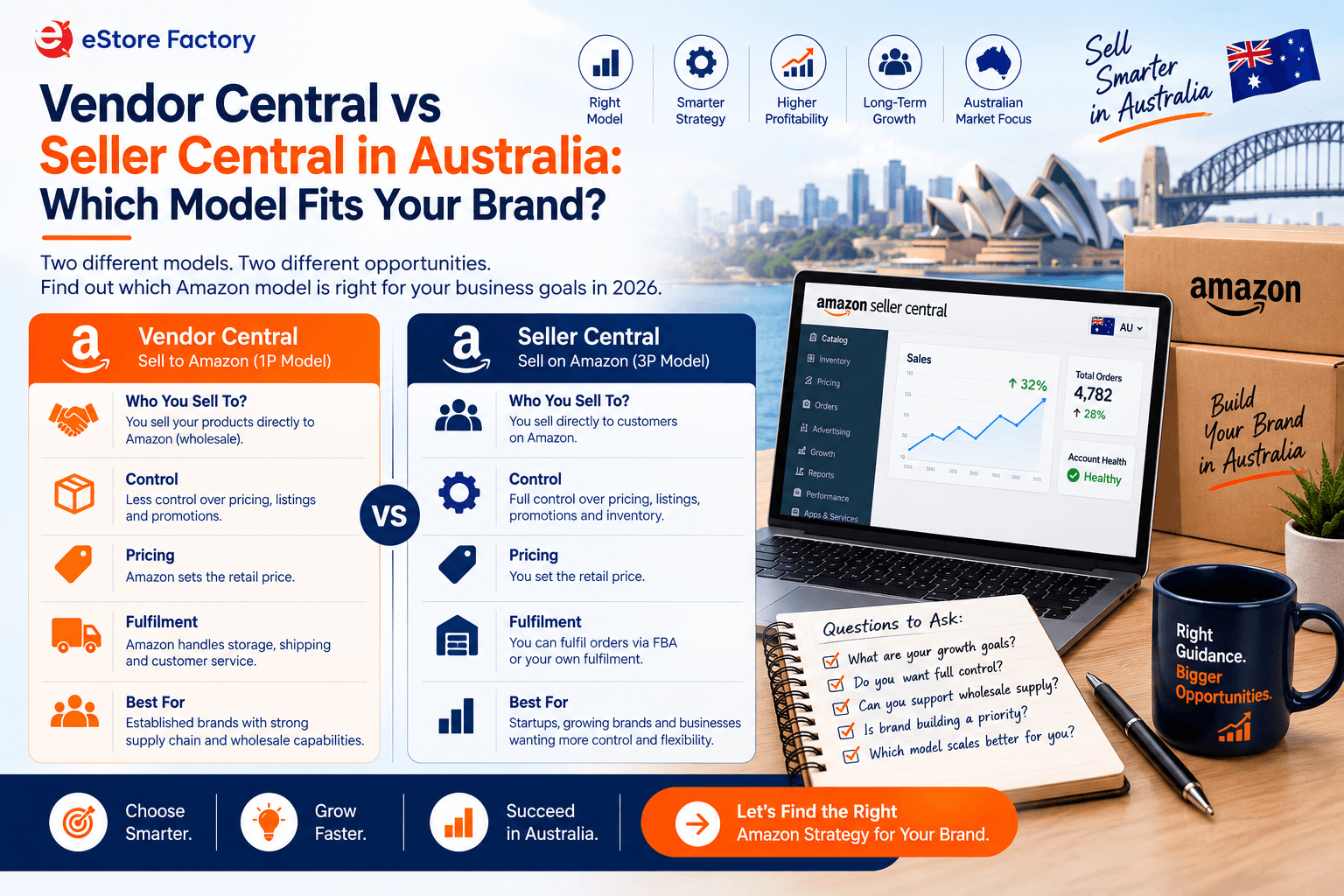
Australian brands looking to sell on Amazon usually assume there's only one way in: create an account, list products, and start selling. In reality, Amazon operates two very different selling models — Vendor Central and Seller Central — and the model you use can shape your pricing, margins, inventory workload, and how much control you keep over your own brand.
This isn't a simple "which one is better" question. Vendor Central and Seller Central serve different kinds of businesses, with different relationships to Amazon itself. And in Australia specifically, the decision looks a little different than it does in the US, mainly because Vendor Central is invite-only here — you can't simply sign up for it the way you can with Seller Central.
Before deciding which path suits your brand, it helps to understand how each model actually works, what trade-offs come with each, and which factors — margins, pricing control, fulfilment, inventory ownership, and cash flow — should drive your decision. If you're still weighing up whether Amazon is the right channel at all, our guide on selling on Amazon Australia is a good place to start.
Vendor Central vs Seller Central in Australia: What's the Difference?
Here's a quick side-by-side before we go into detail:
Factor | Vendor Central | Seller Central |
Relationship with Amazon | Wholesale supplier | Third-party seller |
Access | Invite-only | Brands can register directly |
Customer relationship | Owned by Amazon | Owned by the seller |
Pricing control | Limited | Greater control |
Margin structure | Wholesale pricing | Retail price minus Amazon costs |
Inventory responsibility | Amazon purchases inventory | Seller manages inventory |
Fulfilment | Mainly Amazon-led | Seller-fulfilled or via FBA |
The core distinction comes down to this: in Vendor Central, your brand acts as a supplier to Amazon. In Seller Central, your brand sells directly to the end customer, with Amazon acting more like a marketplace host. That single difference cascades into almost everything else — pricing, margins, and day-to-day operations.
What Is Amazon Vendor Central in Australia?
How Vendor Central Works
Under Vendor Central, Amazon invites a brand to become a first-party supplier. The brand sells its products to Amazon at an agreed wholesale price, and Amazon then owns those products, sets the retail price, and sells them on to customers. In effect, you're not "selling on Amazon" in the traditional sense — you're supplying Amazon, the way you might supply a large retail chain.
This is fundamentally different from Seller Central, where the brand keeps ownership of the customer relationship and the retail transaction all the way through.
Why Vendor Central Is Invite-Only
Unlike Seller Central, you can't simply apply for a Vendor Central account. Amazon extends invitations based on factors like product category, sales potential, and brand fit for its retail catalogue. This means not every Australian business has access to Vendor Central, no matter how much they might want it — and that's an important distinction to keep in mind, since a lot of generic, US-focused guides gloss over this. If an invitation hasn't landed in your inbox, Vendor Central simply isn't an option to plan around yet.
Potential Benefits of Vendor Central
A direct wholesale relationship with Amazon
Amazon owns and manages the retail customer relationship
Potential operational convenience, since Amazon handles listings, pricing, and customer service on the retail side
Amazon-managed fulfilment is typical under this model
Potential Challenges of Vendor Central
Less control over retail pricing, since Amazon sets the final price
Wholesale pricing can compress margins compared with direct retail sales
Your supply volume depends on Amazon's purchase orders, not your own sales strategy
Negotiating terms and payment schedules with Amazon can be a lengthy, formal process
Less direct influence over how your brand appears to the end customer
What Is Amazon Seller Central in Australia?
How Seller Central Works
With Seller Central, your brand sells directly to Amazon customers. You control the seller account, manage your own listings, set your own prices, and make your own decisions about inventory and advertising strategy. Amazon is the marketplace and infrastructure provider — but the retail relationship stays with you.
Benefits of Seller Central
Greater control over pricing decisions
Direct control over product listings, content, and imagery
The ability to run and manage your own promotions and advertising campaigns
More flexibility over inventory levels and fulfilment method — seller-fulfilled or FBA
Clearer visibility into the profitability of each individual product
Challenges of Seller Central
Running a Seller Central account also means owning more of the operational load, including:
Inventory management and replenishment planning
Customer service and returns handling
Amazon referral fees, FBA fees, and other associated costs
If this operational side feels like the bigger hurdle, it's worth looking at what Amazon Seller Central account management actually involves day to day before deciding the workload is too much to take on.
Vendor Central vs Seller Central: Comparing the Margin Trade-Off
This is arguably the most important comparison in the entire decision.
Vendor Central Margin Structure
Under Vendor Central, Amazon purchases your products at an agreed wholesale price. That gives you a degree of revenue predictability and can simplify operations — but it comes with a trade-off. You lose control over the retail price, and your margin is fixed by the wholesale agreement rather than by market demand or your own pricing strategy.
Seller Central Margin Structure
Under Seller Central, you receive the full retail selling price for each unit — but from that figure, you need to account for Amazon's referral fees, fulfillment costs (if using FBA), advertising spend, storage fees, and returns. What's left after all of that is your actual margin.
Why Higher Revenue Doesn't Always Mean Higher Profit
It's easy to look at top-line revenue and assume a bigger number means a better outcome. But the real test is what's left after costs. A simplified way to think about it:
Selling price → Amazon fees → fulfilment costs → advertising spend → storage/returns → product cost → actual profit
A Seller Central listing might generate more revenue per unit than a Vendor Central wholesale price — but by the time referral fees, ad spend, and fulfillment costs are subtracted, the real profit could end up similar, higher, or lower, depending entirely on the specific product and category. Neither model guarantees better margins across the board; it depends on your cost structure, and that's why running the numbers for your specific products matters more than following a general rule.
Vendor Central vs Seller Central Australia: Key Factors to Consider
Pricing Control
Seller Central gives you direct control over retail pricing. Vendor Central hands that control to Amazon, which sets the price it believes will move the most units.
Profit Margins
Wholesale economics (Vendor Central) and direct-to-consumer economics (Seller Central) work differently enough that margin comparisons need to be done at the product level, not as a blanket assumption.
Inventory Management
Under Vendor Central, Amazon purchases and owns the inventory once it's ordered. Under Seller Central, you carry the responsibility for stock levels, replenishment timing, and avoiding stockouts or overstock.
Fulfilment
Vendor Central is typically Amazon-led on the fulfillment side. Seller Central gives you the choice between fulfilling orders yourself or using Fulfilment by Amazon (FBA), each with its own cost and effort trade-offs.
Brand Control
Seller Central puts you in charge of product listings, A+ content, promotions, and how your brand is presented to shoppers. Vendor Central hands more of that customer-facing experience to Amazon.
Cash Flow
Payment structures differ meaningfully between the two. Vendor Central typically involves payment terms tied to purchase orders (which can mean longer payment cycles), while Seller Central payouts follow Amazon's standard seller disbursement schedule. Since inventory ownership also shifts between the two models, cash flow planning needs to account for both when and how you get paid.
Which Amazon Model Is Better for Australian Brands?
There's no single right answer — it depends on your business's structure, goals, and operational capacity.
Seller Central May Be Better If...
You want greater control over pricing
You want direct oversight of your Amazon business and how it's presented
You're comfortable — or want to build the capability — to manage inventory and daily operations
You want to actively run and optimise your own advertising and listings
Vendor Central May Be Better If...
Amazon has actually invited your brand to the program
You prefer a wholesale-style relationship rather than direct retail management
Your business has the supply chain and production capacity to fulfil Amazon's purchase orders consistently
You're comfortable with Amazon managing more of the retail-side experience
Can an Australian Brand Use Both Vendor Central and Seller Central?
It's technically possible for a brand to operate a hybrid model — for example, supplying certain products through Vendor Central (if invited) while selling other products or the same products through Seller Central. Some larger brands do run both.
But this isn't automatically the right move for every business. Running both introduces real complications that need careful planning:
Channel conflict — the same product being sold under two different pricing structures can create confusion or price competition against yourself
Pricing — keeping pricing consistent (or intentionally differentiated) across both channels takes active management
Inventory — splitting stock across two supply arrangements adds forecasting complexity
Product selection — deciding which SKUs go where isn't always straightforward
Brand consistency — customer experience can vary between a Vendor-fulfilled listing and a Seller-fulfilled one
Profitability — the combined cost and margin picture needs to be modelled carefully, not assumed
For most brands starting out, choosing one model and getting it right is more manageable than juggling both from day one.
How to Choose Between Vendor Central and Seller Central in Australia
A simple framework to work through:
Is Vendor Central actually available to your brand? If you haven't been invited, this narrows the decision considerably.
How much pricing control do you need?
What margin do you need to achieve to make the channel worthwhile?
Who will manage fulfilment — you, a 3PL, FBA, or Amazon directly?
How much operational control do you want over listings, promotions, and customer experience?
What is your current Amazon sales volume, and can it support the chosen model?
How will the model affect your cash flow, given differing payment terms and inventory ownership?
Can your team manage Amazon operations internally, or will you need external support?
If you're not sure how to answer some of these questions with confidence, working through getting started on Amazon or getting help with your Amazon account setup can help you map out the practical side before committing to a model.
Why Australian Brands May Need Amazon Account Management Support
Whichever model you choose — or if you're deciding between the two — managing an Amazon business well takes ongoing, hands-on work. This is especially true for Seller Central, where the operational responsibility sits with you.
Professional Amazon account management support can help with:
Day-to-day Amazon Seller Central account management
Product listing optimisation to improve visibility and conversion
Amazon advertising strategy and campaign management
Inventory planning to avoid stockouts and overstock
FBA support and fulfilment strategy
Pricing and profitability analysis at the product level
Amazon Australia marketplace strategy tailored to local buyer behaviour
Ongoing account performance monitoring and reporting
This is where an experienced partner like eStoreFactory can make a meaningful difference — not by pushing you toward one model over the other, but by helping you understand what each option actually means for your specific products, margins, and growth plans, and then managing the operational detail so your team doesn't have to do it alone.
Final Verdict: Vendor Central or Seller Central?
There's no universal winner between Vendor Central and Seller Central in Australia. Vendor Central can suit brands that have been invited by Amazon and prefer a wholesale-style relationship with less day-to-day retail involvement. Seller Central can offer more control over pricing, listings, and overall Amazon strategy — at the cost of taking on more of the operational workload yourself.
The right choice ultimately depends on your profitability targets, how much control you want to retain, your operational capacity, and your broader business goals. For many Australian brands without a Vendor Central invitation, Seller Central is the practical starting point — and even for brands weighing a future Vendor invitation, understanding Seller Central's economics first gives you a useful benchmark for comparison.
Whichever direction fits your brand, treating this as a numbers-and-capacity decision — rather than a "which platform sounds better" decision — will put you in a stronger position either way.
Want to build a stronger Amazon Australia strategy?
Partner with eStoreFactory for expert Amazon account management, marketplace optimisation, and growth support tailored to your brand. Get in touch to talk through which model — and which strategy — fits where your business is headed.
Australian brands looking to sell on Amazon usually assume there's only one way in: create an account, list products, and start selling. In reality, Amazon operates two very different selling models — Vendor Central and Seller Central — and the model you use can shape your pricing, margins, inventory workload, and how much control you keep over your own brand.
This isn't a simple "which one is better" question. Vendor Central and Seller Central serve different kinds of businesses, with different relationships to Amazon itself. And in Australia specifically, the decision looks a little different than it does in the US, mainly because Vendor Central is invite-only here — you can't simply sign up for it the way you can with Seller Central.
Before deciding which path suits your brand, it helps to understand how each model actually works, what trade-offs come with each, and which factors — margins, pricing control, fulfilment, inventory ownership, and cash flow — should drive your decision. If you're still weighing up whether Amazon is the right channel at all, our guide on selling on Amazon Australia is a good place to start.
Vendor Central vs Seller Central in Australia: What's the Difference?
Here's a quick side-by-side before we go into detail:
Factor | Vendor Central | Seller Central |
Relationship with Amazon | Wholesale supplier | Third-party seller |
Access | Invite-only | Brands can register directly |
Customer relationship | Owned by Amazon | Owned by the seller |
Pricing control | Limited | Greater control |
Margin structure | Wholesale pricing | Retail price minus Amazon costs |
Inventory responsibility | Amazon purchases inventory | Seller manages inventory |
Fulfilment | Mainly Amazon-led | Seller-fulfilled or via FBA |
The core distinction comes down to this: in Vendor Central, your brand acts as a supplier to Amazon. In Seller Central, your brand sells directly to the end customer, with Amazon acting more like a marketplace host. That single difference cascades into almost everything else — pricing, margins, and day-to-day operations.
What Is Amazon Vendor Central in Australia?
How Vendor Central Works
Under Vendor Central, Amazon invites a brand to become a first-party supplier. The brand sells its products to Amazon at an agreed wholesale price, and Amazon then owns those products, sets the retail price, and sells them on to customers. In effect, you're not "selling on Amazon" in the traditional sense — you're supplying Amazon, the way you might supply a large retail chain.
This is fundamentally different from Seller Central, where the brand keeps ownership of the customer relationship and the retail transaction all the way through.
Why Vendor Central Is Invite-Only
Unlike Seller Central, you can't simply apply for a Vendor Central account. Amazon extends invitations based on factors like product category, sales potential, and brand fit for its retail catalogue. This means not every Australian business has access to Vendor Central, no matter how much they might want it — and that's an important distinction to keep in mind, since a lot of generic, US-focused guides gloss over this. If an invitation hasn't landed in your inbox, Vendor Central simply isn't an option to plan around yet.
Potential Benefits of Vendor Central
A direct wholesale relationship with Amazon
Amazon owns and manages the retail customer relationship
Potential operational convenience, since Amazon handles listings, pricing, and customer service on the retail side
Amazon-managed fulfilment is typical under this model
Potential Challenges of Vendor Central
Less control over retail pricing, since Amazon sets the final price
Wholesale pricing can compress margins compared with direct retail sales
Your supply volume depends on Amazon's purchase orders, not your own sales strategy
Negotiating terms and payment schedules with Amazon can be a lengthy, formal process
Less direct influence over how your brand appears to the end customer
What Is Amazon Seller Central in Australia?
How Seller Central Works
With Seller Central, your brand sells directly to Amazon customers. You control the seller account, manage your own listings, set your own prices, and make your own decisions about inventory and advertising strategy. Amazon is the marketplace and infrastructure provider — but the retail relationship stays with you.
Benefits of Seller Central
Greater control over pricing decisions
Direct control over product listings, content, and imagery
The ability to run and manage your own promotions and advertising campaigns
More flexibility over inventory levels and fulfilment method — seller-fulfilled or FBA
Clearer visibility into the profitability of each individual product
Challenges of Seller Central
Running a Seller Central account also means owning more of the operational load, including:
Inventory management and replenishment planning
Customer service and returns handling
Amazon referral fees, FBA fees, and other associated costs
If this operational side feels like the bigger hurdle, it's worth looking at what Amazon Seller Central account management actually involves day to day before deciding the workload is too much to take on.
Vendor Central vs Seller Central: Comparing the Margin Trade-Off
This is arguably the most important comparison in the entire decision.
Vendor Central Margin Structure
Under Vendor Central, Amazon purchases your products at an agreed wholesale price. That gives you a degree of revenue predictability and can simplify operations — but it comes with a trade-off. You lose control over the retail price, and your margin is fixed by the wholesale agreement rather than by market demand or your own pricing strategy.
Seller Central Margin Structure
Under Seller Central, you receive the full retail selling price for each unit — but from that figure, you need to account for Amazon's referral fees, fulfillment costs (if using FBA), advertising spend, storage fees, and returns. What's left after all of that is your actual margin.
Why Higher Revenue Doesn't Always Mean Higher Profit
It's easy to look at top-line revenue and assume a bigger number means a better outcome. But the real test is what's left after costs. A simplified way to think about it:
Selling price → Amazon fees → fulfilment costs → advertising spend → storage/returns → product cost → actual profit
A Seller Central listing might generate more revenue per unit than a Vendor Central wholesale price — but by the time referral fees, ad spend, and fulfillment costs are subtracted, the real profit could end up similar, higher, or lower, depending entirely on the specific product and category. Neither model guarantees better margins across the board; it depends on your cost structure, and that's why running the numbers for your specific products matters more than following a general rule.
Vendor Central vs Seller Central Australia: Key Factors to Consider
Pricing Control
Seller Central gives you direct control over retail pricing. Vendor Central hands that control to Amazon, which sets the price it believes will move the most units.
Profit Margins
Wholesale economics (Vendor Central) and direct-to-consumer economics (Seller Central) work differently enough that margin comparisons need to be done at the product level, not as a blanket assumption.
Inventory Management
Under Vendor Central, Amazon purchases and owns the inventory once it's ordered. Under Seller Central, you carry the responsibility for stock levels, replenishment timing, and avoiding stockouts or overstock.
Fulfilment
Vendor Central is typically Amazon-led on the fulfillment side. Seller Central gives you the choice between fulfilling orders yourself or using Fulfilment by Amazon (FBA), each with its own cost and effort trade-offs.
Brand Control
Seller Central puts you in charge of product listings, A+ content, promotions, and how your brand is presented to shoppers. Vendor Central hands more of that customer-facing experience to Amazon.
Cash Flow
Payment structures differ meaningfully between the two. Vendor Central typically involves payment terms tied to purchase orders (which can mean longer payment cycles), while Seller Central payouts follow Amazon's standard seller disbursement schedule. Since inventory ownership also shifts between the two models, cash flow planning needs to account for both when and how you get paid.
Which Amazon Model Is Better for Australian Brands?
There's no single right answer — it depends on your business's structure, goals, and operational capacity.
Seller Central May Be Better If...
You want greater control over pricing
You want direct oversight of your Amazon business and how it's presented
You're comfortable — or want to build the capability — to manage inventory and daily operations
You want to actively run and optimise your own advertising and listings
Vendor Central May Be Better If...
Amazon has actually invited your brand to the program
You prefer a wholesale-style relationship rather than direct retail management
Your business has the supply chain and production capacity to fulfil Amazon's purchase orders consistently
You're comfortable with Amazon managing more of the retail-side experience
Can an Australian Brand Use Both Vendor Central and Seller Central?
It's technically possible for a brand to operate a hybrid model — for example, supplying certain products through Vendor Central (if invited) while selling other products or the same products through Seller Central. Some larger brands do run both.
But this isn't automatically the right move for every business. Running both introduces real complications that need careful planning:
Channel conflict — the same product being sold under two different pricing structures can create confusion or price competition against yourself
Pricing — keeping pricing consistent (or intentionally differentiated) across both channels takes active management
Inventory — splitting stock across two supply arrangements adds forecasting complexity
Product selection — deciding which SKUs go where isn't always straightforward
Brand consistency — customer experience can vary between a Vendor-fulfilled listing and a Seller-fulfilled one
Profitability — the combined cost and margin picture needs to be modelled carefully, not assumed
For most brands starting out, choosing one model and getting it right is more manageable than juggling both from day one.
How to Choose Between Vendor Central and Seller Central in Australia
A simple framework to work through:
Is Vendor Central actually available to your brand? If you haven't been invited, this narrows the decision considerably.
How much pricing control do you need?
What margin do you need to achieve to make the channel worthwhile?
Who will manage fulfilment — you, a 3PL, FBA, or Amazon directly?
How much operational control do you want over listings, promotions, and customer experience?
What is your current Amazon sales volume, and can it support the chosen model?
How will the model affect your cash flow, given differing payment terms and inventory ownership?
Can your team manage Amazon operations internally, or will you need external support?
If you're not sure how to answer some of these questions with confidence, working through getting started on Amazon or getting help with your Amazon account setup can help you map out the practical side before committing to a model.
Why Australian Brands May Need Amazon Account Management Support
Whichever model you choose — or if you're deciding between the two — managing an Amazon business well takes ongoing, hands-on work. This is especially true for Seller Central, where the operational responsibility sits with you.
Professional Amazon account management support can help with:
Day-to-day Amazon Seller Central account management
Product listing optimisation to improve visibility and conversion
Amazon advertising strategy and campaign management
Inventory planning to avoid stockouts and overstock
FBA support and fulfilment strategy
Pricing and profitability analysis at the product level
Amazon Australia marketplace strategy tailored to local buyer behaviour
Ongoing account performance monitoring and reporting
This is where an experienced partner like eStoreFactory can make a meaningful difference — not by pushing you toward one model over the other, but by helping you understand what each option actually means for your specific products, margins, and growth plans, and then managing the operational detail so your team doesn't have to do it alone.
Final Verdict: Vendor Central or Seller Central?
There's no universal winner between Vendor Central and Seller Central in Australia. Vendor Central can suit brands that have been invited by Amazon and prefer a wholesale-style relationship with less day-to-day retail involvement. Seller Central can offer more control over pricing, listings, and overall Amazon strategy — at the cost of taking on more of the operational workload yourself.
The right choice ultimately depends on your profitability targets, how much control you want to retain, your operational capacity, and your broader business goals. For many Australian brands without a Vendor Central invitation, Seller Central is the practical starting point — and even for brands weighing a future Vendor invitation, understanding Seller Central's economics first gives you a useful benchmark for comparison.
Whichever direction fits your brand, treating this as a numbers-and-capacity decision — rather than a "which platform sounds better" decision — will put you in a stronger position either way.
Want to build a stronger Amazon Australia strategy?
Partner with eStoreFactory for expert Amazon account management, marketplace optimisation, and growth support tailored to your brand. Get in touch to talk through which model — and which strategy — fits where your business is headed.





eStore Factory is a full-service Amazon agency dedicated to building end-to-end strategies for brands of all sizes.


ACCOUNT LAUNCH
OTHERS
© Copyright 2014 - 2026. All Rights Reserved.
eStore Factory is a full-service Amazon agency dedicated to building end-to-end strategies for brands of all sizes.
ACCOUNT LAUNCH
OTHERS
© Copyright 2014 - 2026. All Rights Reserved.
eStore Factory is a full-service Amazon agency dedicated to building end-to-end strategies for brands of all sizes.
ACCOUNT LAUNCH
OTHERS
© Copyright 2014 - 2026. All Rights Reserved.